

Dashboard
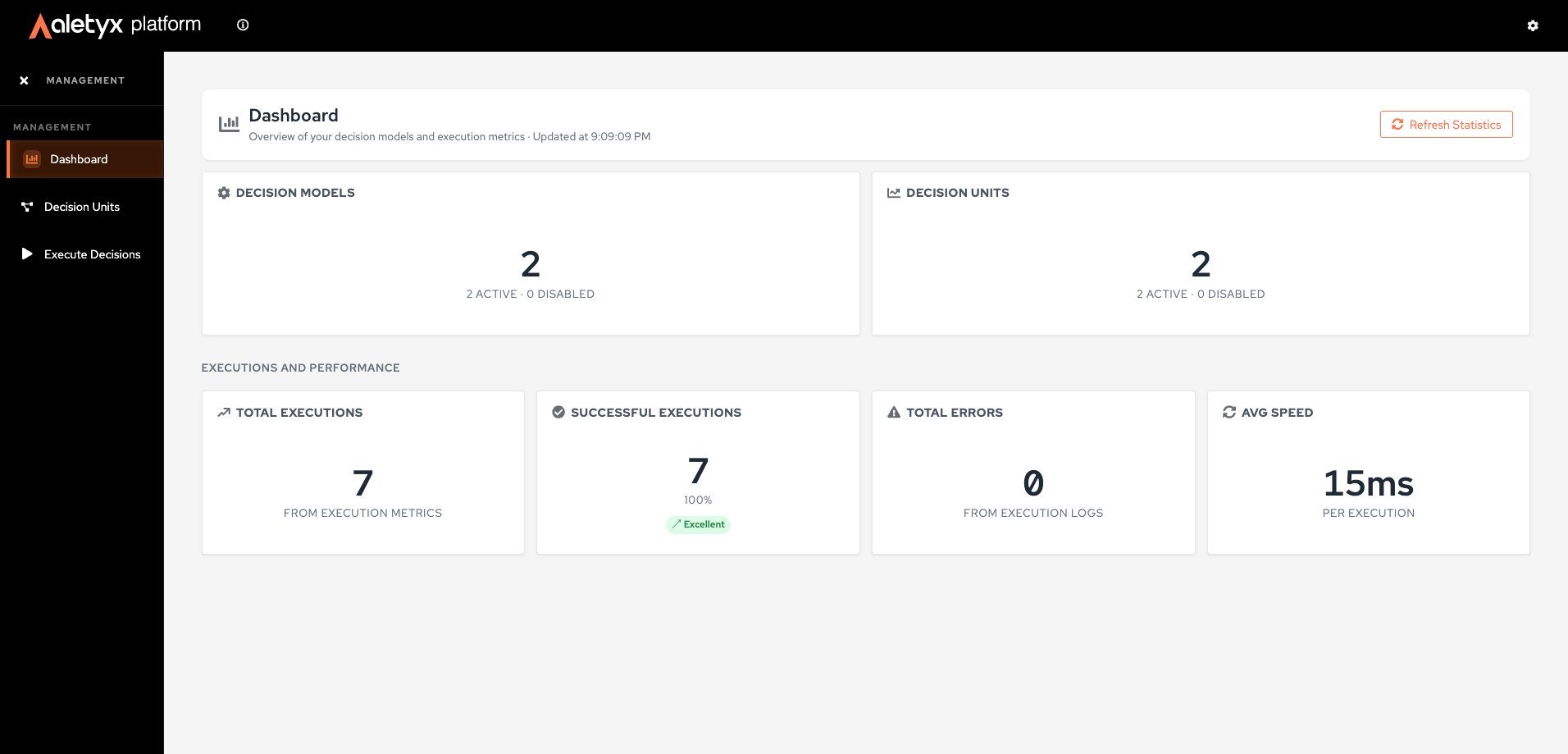
Each card is clickable and links to its detail screen.
How to view dashboard metrics
Steps:- Open Management → Dashboard (the default screen).
- Read the metric cards (see the table above).
- (Optional) Click a card to jump to its detail screen.
<time>” timestamp.
How to refresh dashboard statistics
Pull the latest metrics on demand. Steps:- On the Dashboard, click Refresh Statistics.
Decision Units
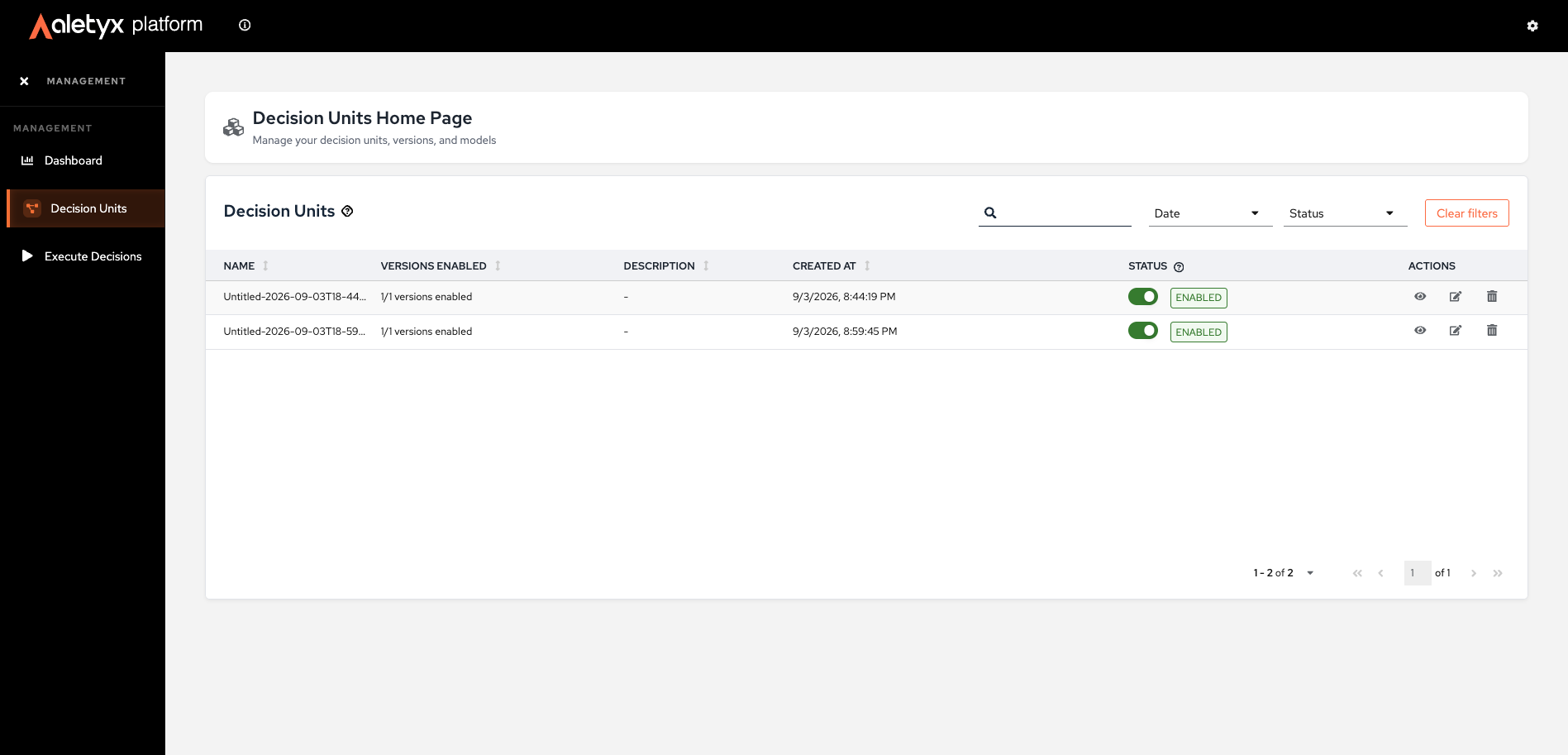
Units aren’t created emptyA decision unit comes into existence only when you publish a model from Decisions. The “Create Decision Unit” button on the dashboard simply opens the Units page. To bring an existing model in first, see how to import an existing model.
How to find a decision unit
Locate units by name, date, or status. Steps:- Open Management → Decision Units.
- Type in Search, and/or use the Date and Status filters.
- Sort by clicking column headers; click Clear filters to reset.
How to enable or disable a decision unit
Make a unit’s models available (or not) as API endpoints. Steps:- On Decision Units, find the unit’s row.
- Toggle the STATUS switch (shows ENABLED/DISABLED).
How to view a unit’s versions and models
Drill into a unit to manage its versions and models. Steps:- On Decision Units, click the unit row (or the eye icon).
How to edit a unit’s description
Update a unit’s descriptive text. Steps:- On Decision Units, click the pencil icon in the unit’s ACTIONS column.
- Edit Description and click Save Changes.
How to delete a decision unit
Permanently remove a unit and all its versions/models. Steps:- On Decision Units, click the trash icon in the unit’s row.
- Review the cascade warning and click Delete.
- If a conflict appears, confirm the force-delete option.
Versions & Models
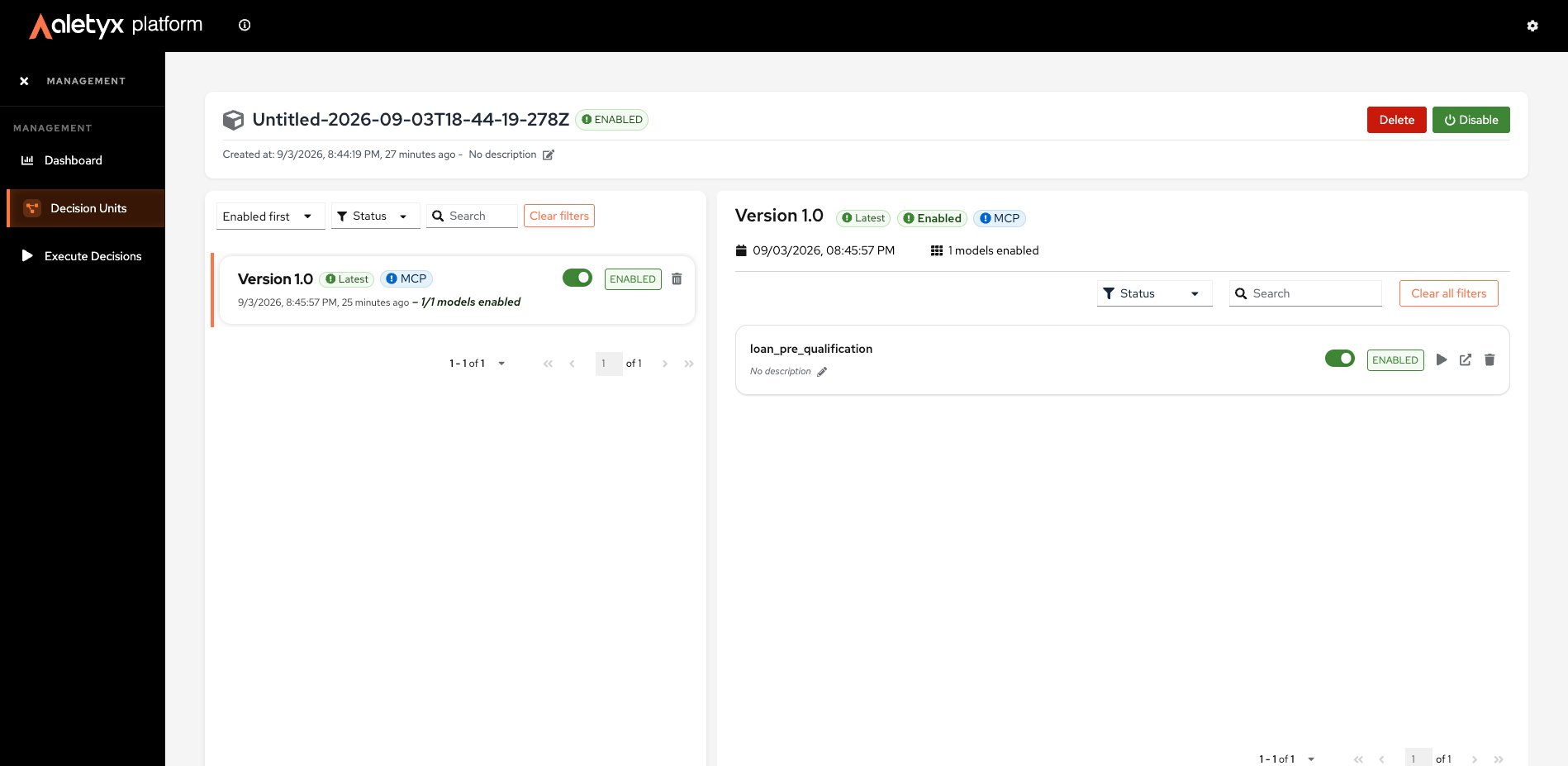
How to manage versions of a unit
Browse, filter, and act on a unit’s versions. Prerequisites: On a unit’s versions page. Steps:- Use Search, the Status filter, or the sort dropdown in the left panel.
- Click a version card to load its models on the right.
How to enable or disable a version
Control whether a whole version is live. Steps:- On a version card, click the status control (tooltip: “Click to change the version status”).
How to delete a version
Remove a single version of a unit. Steps:- On the version card, click the trash icon.
- Confirm in the delete dialog.
How to enable or disable a model
Toggle an individual model within a version. Prerequisites: A version selected. Steps:- On the model card (right panel), toggle the status control. (The parent unit/version auto-enable if needed.)
How to edit a model’s description
Annotate a specific model. Steps:- On the model card, click the pencil icon.
- Edit the description and save.
How to delete a model
Remove a single model from a version. Steps:- On the model card, click the trash icon and confirm.
How to open a model in the editor from the version page
Jump from a managed model into the authoring editor. Prerequisites: Authoring access to edit. Steps:- On the model card, click the external-link icon (Open model).
How to execute a model from the version page
Quickly send a managed model to the execution screen. Prerequisites: The model enabled. Steps:- On the model card, click the play icon (Play model).
How to visualize a model
Inspect a model’s overview, DMN XML, JSON schema, and diagram. Steps:- Open the model’s Visualize view (for example, from a model’s actions).
- Switch among the tabs: Overview, DMN XML, JSON Schema, Visualize.