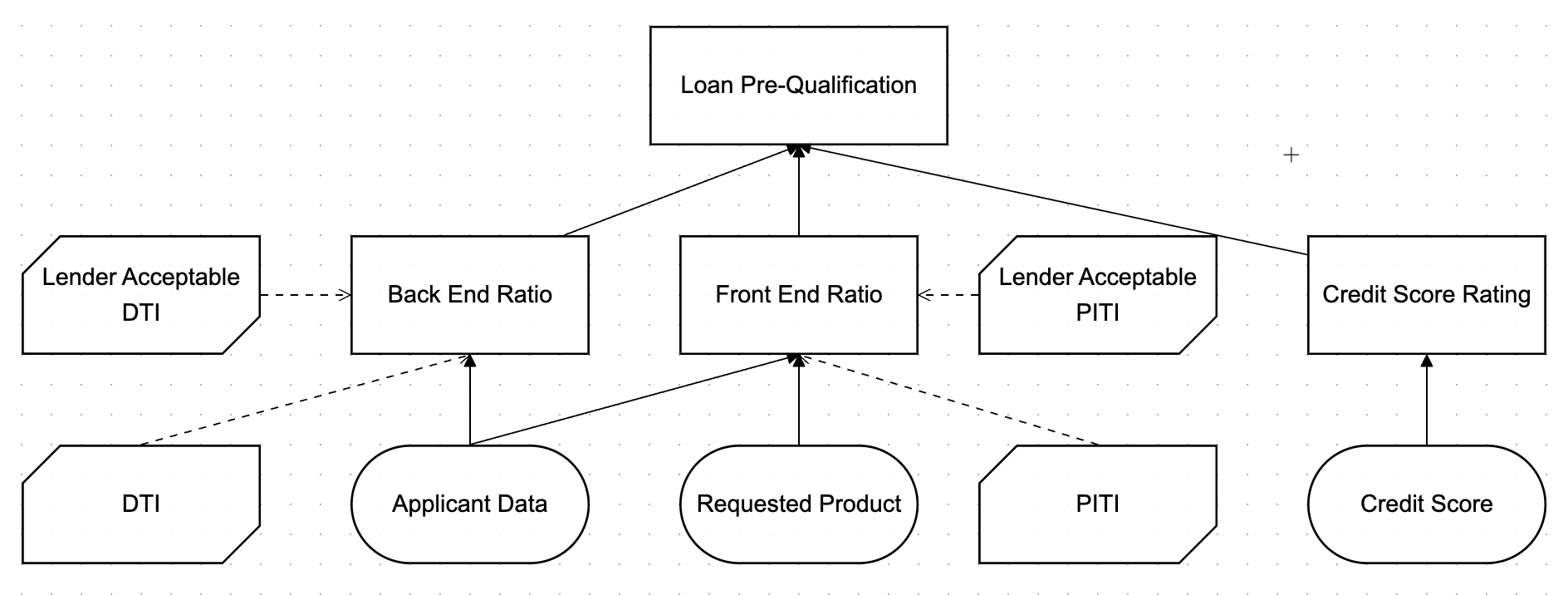
DMN (Decision Model and Notation) is an OMG standard for modeling business decisions visually. Instead of burying logic in code, you describe what the decision is, what inputs it needs, and how the inputs map to outcomes — using decision tables and boxed expressions written in FEEL (Friendly Enough Expression Language). Because it is a portable, vendor-neutral standard, the same DMN model can be read by business analysts, validated by compliance teams, and executed directly by an engine — no translation step between the diagram and the running logic. A DMN model usually has two parts: a Decision Requirements Diagram (DRD) that shows which inputs feed which decisions, and a decision table that spells out the rules.
DMN example showing a decision requirements diagram and a loan eligibility decision table

A simple DMN model: the Applicant Data input feeds a Loan Eligibility decision, whose rules live in a decision table.

If you can read a spreadsheet, you can read the decision table: conditions on the left, outcomes on the right.

Where to go next

Introduction to DMN

Learn the building blocks — decision tables, DRDs, and FEEL — from the ground up.

Try it in the Playground

Build and run an executable DMN model directly in the Aletyx Playground.

Basic Examples

Walk through a worked example, from inputs to a decision table.

Advanced Modeling

Go deeper with multi-decision DRDs and more expressive FEEL.

DMN Reference

Look up FEEL syntax, reserved words, and expression details.

Deploy DMN

Package and deploy decision models as runnable services.